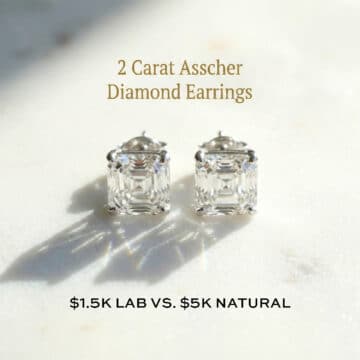



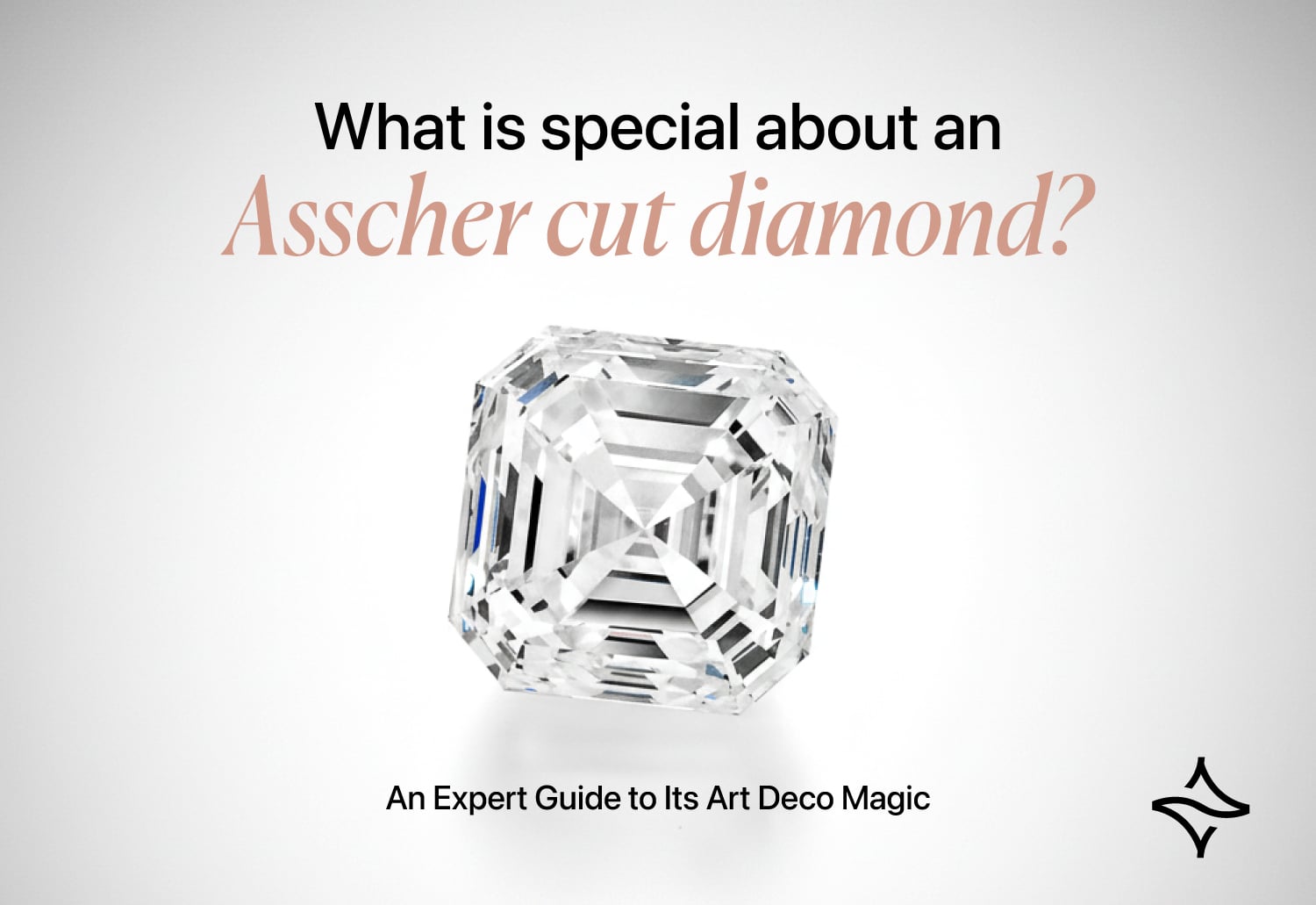
An Asscher Cut is a square “Step Cut” diamond defined by its deep pavilion, cropped corners, and the signature “Windmill” reflection pattern in the center. Unlike round diamonds that hide flaws with chaotic sparkle, the Asscher acts like a Hall of Mirrors—it is unforgiving and hides nothing.
To get a good one, you need a higher Clarity grade (VS2+) and a perfect Length-to-Width ratio (1.00–1.05). The upside? They are typically 20% cheaper than round diamonds of the same carat weight.
Mehedi’s Buying Verdict: The 2026 Cheat Sheet
- The “Windmill” Rule: If you look into the center and don’t see a crisp “X” pattern, the stone is cut poorly. Walk away.
- The Clarity Trap: Asschers have a massive, open table (window). SI1 stones are rarely eye-clean. Stick to VS2 or VS1 to avoid seeing black spots.
- The Size Warning: Asschers carry their weight deep in the bottom. A 1.00ct Asscher looks significantly smaller than a 1.00ct Round. Buy the dimensions (mm), not just the carat weight.
- The Smart Buy: James Allen or Blue Nile. You must use their 360° videos to verify the Windmill pattern. Buying an Asscher blind based on a certificate is financial suicide.
Optical Precision: Audit the “Windmill” pattern in 40x Super-Zoom HD. Secure GIA-certified Asscher cuts and True Hearts™ signature styles with 20% OFF settings at James Allen .
Elite Vault: Access the Clear The Vault Sale for premium Asscher Cut inventory. Explore the Astor by Blue Nile collection for the ultimate in Art Deco brilliance at Blue Nile .
Diamond IQ Test: Natural or Lab-Grown?
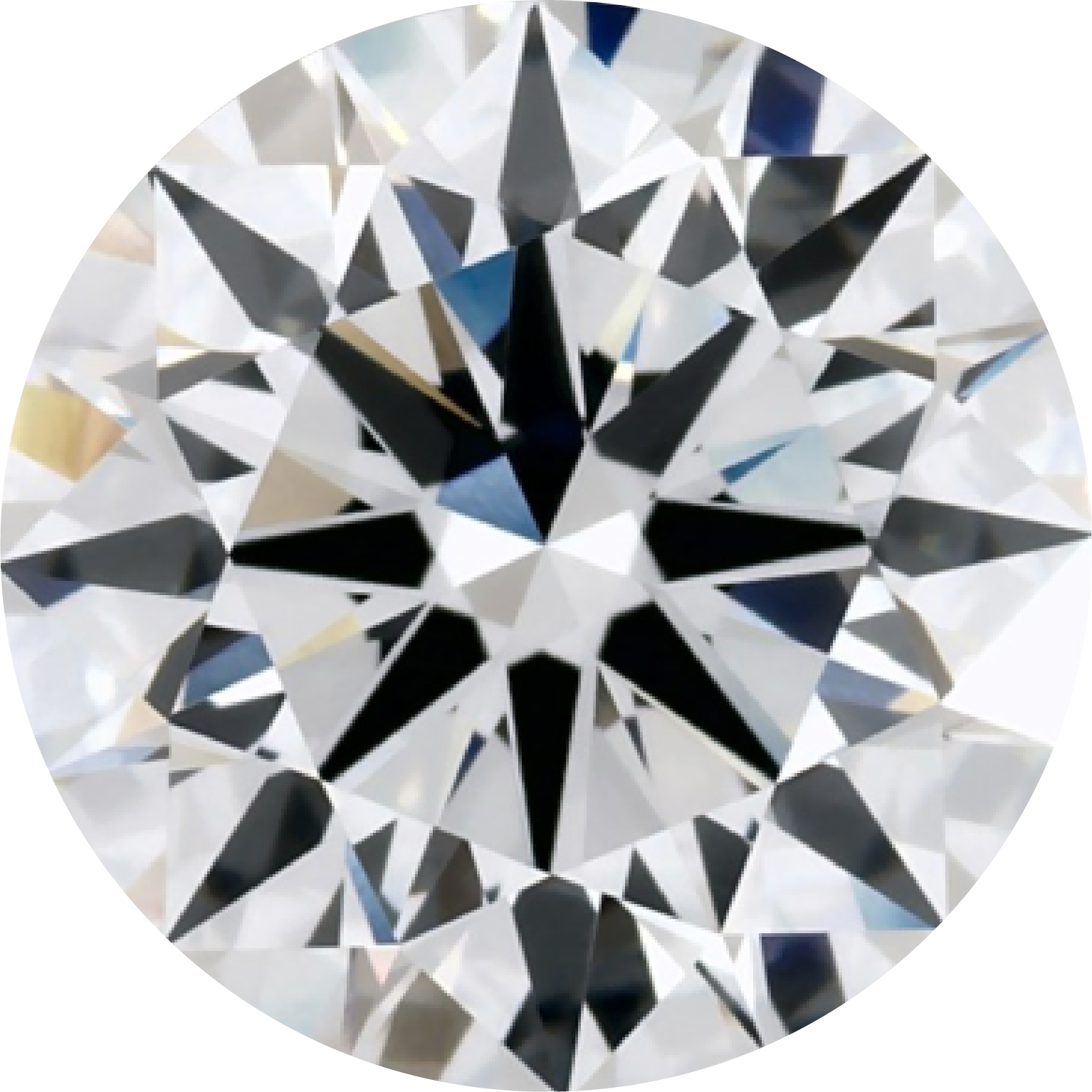
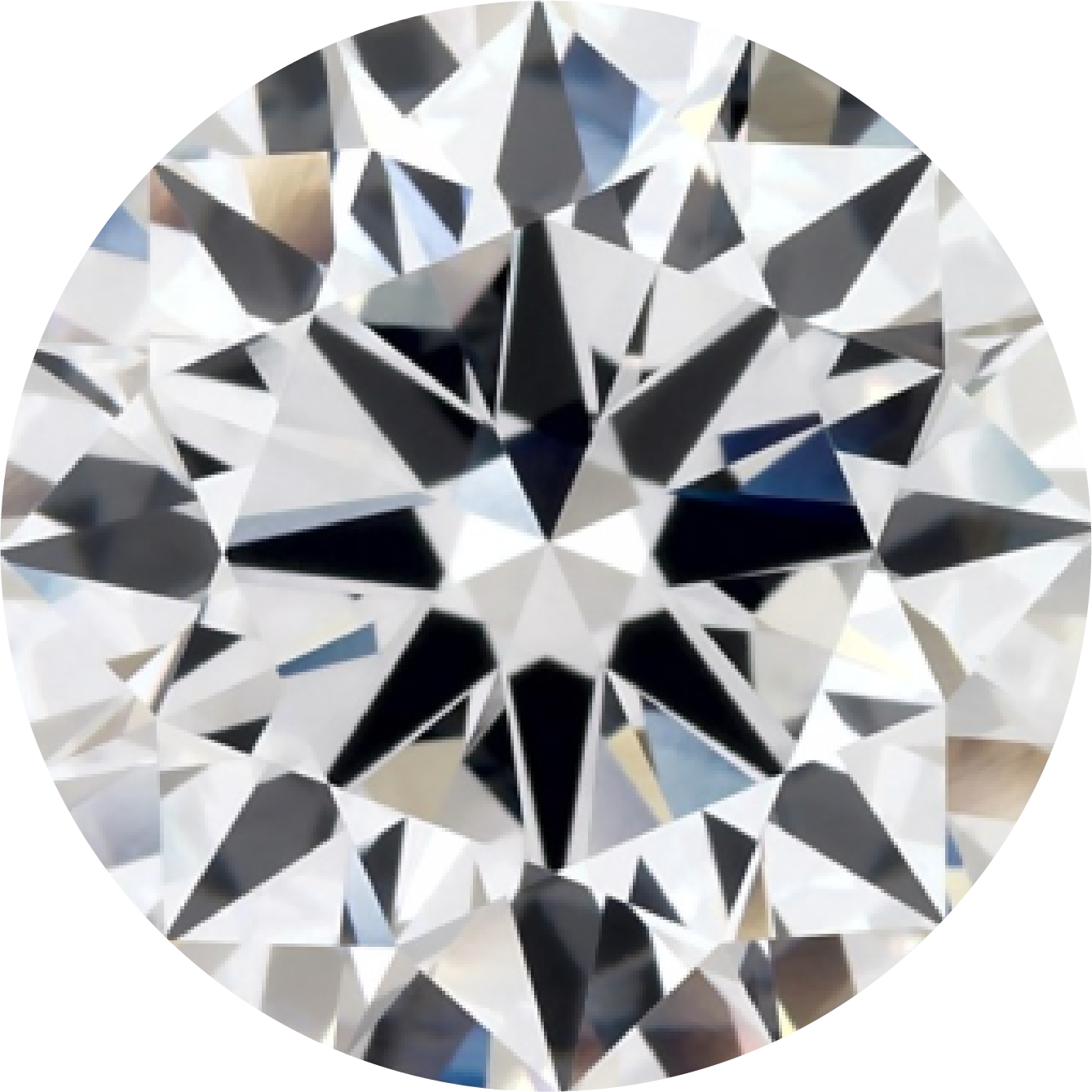
Two identical diamonds: GIA Certified, 1.51ct, D Color, VVS1, Ideal Cut. One is natural ($16,530), the other is lab-grown ($2,390). Choose the diamond you like better and see if you can match it to its origin.
From the 1920s Jazz Age to Modern Masterpiece
Before you can truly appreciate the Asscher cut, you have to understand that you’re not just looking at a diamond—you’re looking at a piece of history. This isn’t a modern, computer-designed shape.
Its story begins in 1902 with a man named Joseph Asscher, a member of the legendary Asscher diamond dynasty of Holland. He created a cut that was so unique, so visionary, that he patented it.
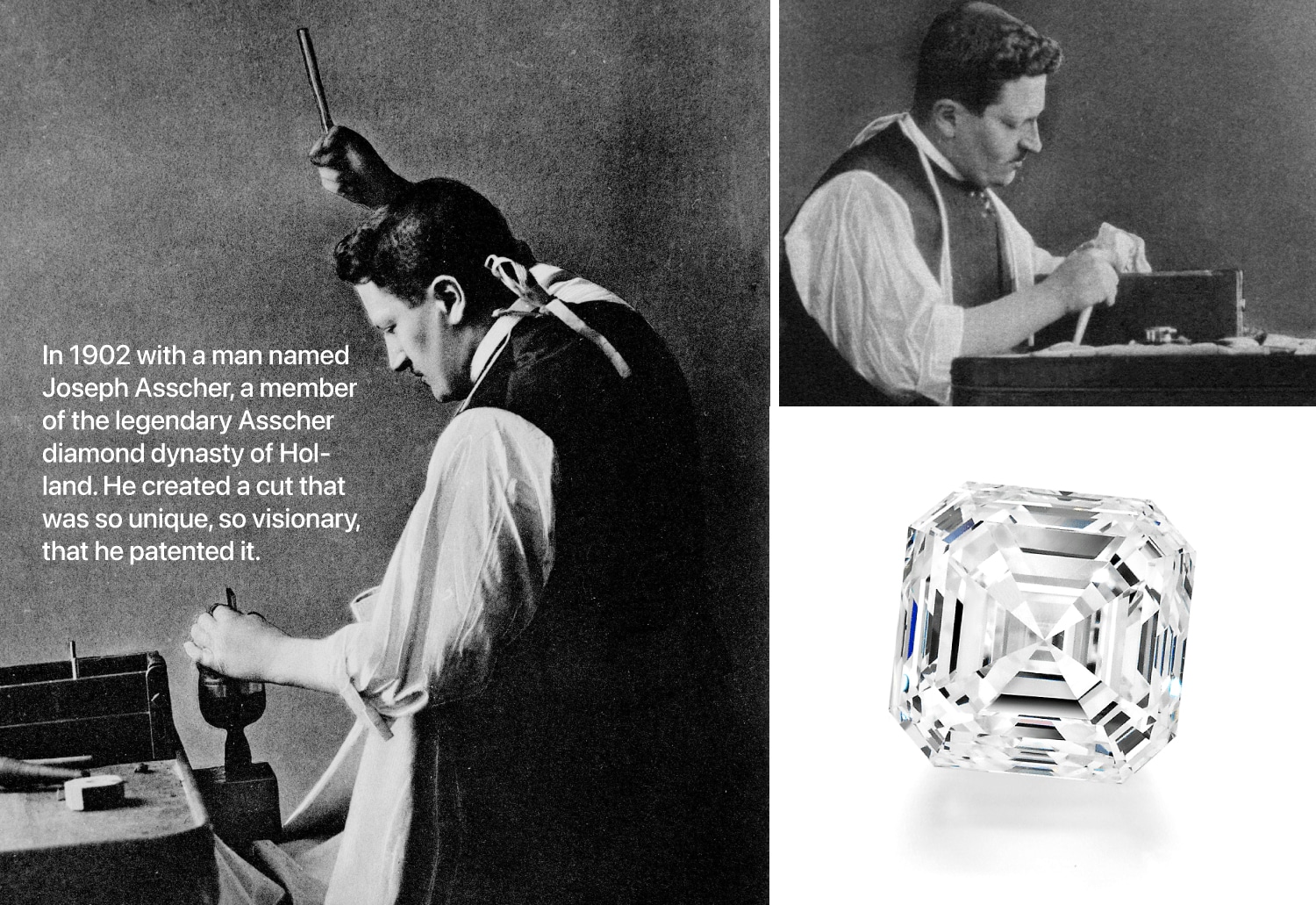
But the Asscher cut truly found its soul during the Roaring Twenties. In the midst of the Jazz Age, with its bold architecture, flapper dresses, and Great Gatsby glamour, the world fell in love with the Asscher’s clean, geometric lines.
It was the perfect gem for the Art Deco movement—confident, sophisticated, and utterly unique. That timeless, vintage vibe is baked into its very DNA.
Now, as much as I adore this cut for its history and character, my job is to be your honest friend and give you the full picture. The Asscher is a connoisseur’s choice, and its unique beauty comes with a unique set of challenges. Here is my straightforward breakdown of the pros and cons you absolutely must understand.
| The Pros of an Asscher Cut | The Cons of an Asscher Cut |
|---|---|
| Hall-of-Mirrors Effect: Offers a hypnotic, architectural flash that is distinct from the “sparkle” of brilliant cuts. | Clarity is Critical: Step-cuts show inclusions easily. You strictly need VS2 or better to ensure an eye-clean look. |
| Art Deco Elegance: A timeless, vintage silhouette that remains the standard for sophisticated, geometric design. | Color Retention: The large open table traps color. We recommend staying in the G-H range for white metals. |
| Exceptional Value: Typically offers a much lower price-per-carat than Round Brilliants. | No GIA Cut Grade: GIA does not grade Asscher cuts for “Cut,” meaning you must manually vet proportions. |
| High Durability: The cropped corners make it much more resistant to chipping than a Princess cut. | Visual Size: Due to their depth, Asscher cuts face up smaller than rounds or ovals of the same carat weight. |
| The 2026 Buying Verdict: The Asscher cut is a “connoisseur’s stone.” While it doesn’t have the fire of a round, its depth and clarity offer a unique sophistication. | |
Let’s be clear about what this table is telling you. You’ve chosen a shape that offers incredible, unique style and fantastic value for your money.
But if you look at that “Cons” column, you’ll see a list of challenges that can trap an unprepared buyer. This is not a “buy it off the certificate” diamond like some other shapes we discuss in our Diamond Shapes Guide. An Asscher cut demands a more careful, educated approach.
These challenges aren’t meant to scare you off; they are the exact reason you need a clear blueprint. Now, let’s go through them one by one so you can choose your Asscher cut with the confidence of an expert.
7 Mistakes to Avoid When Buying an Asscher Cut (A Jeweler’s Guide)
You have fallen for the Asscher cut because of its Art Deco soul. It is geometric, hypnotic, and unapologetically vintage. But here is the cold reality: The Asscher is the most unforgiving diamond shape in existence.
With a Round Brilliant diamond, the chaotic sparkle (scintillation) acts like makeup—it hides flaws, masks yellow tints, and covers up bad cutting. The Asscher cut has no makeup. It is a “Step Cut,” meaning it is composed of long, parallel facets that act like mirrors.
If there is a flaw, the mirrors reflect it. If the cut is slightly off, the pattern collapses.
Most buyers treat an Asscher like a Round diamond, and that is why they end up with a stone that looks like a “dull glass cube” rather than a “Hall of Mirrors.”
As your friend in the trade, I am going to walk you through the 7 Deadly Mistakes that kill the beauty of an Asscher cut, and exactly how to avoid them.
Mistake #1: Ignoring the “Windmill” Pattern (The Soul of the Stone)
This is the single most critical visual test for an Asscher cut, and yet 90% of buyers don’t even know to look for it.
When you look directly into the center of a well-cut Asscher, you should see a distinct, concentric pattern of steps that converge in the middle to form a “Windmill” or an “X” shape.
- The Trap: Many generic Asscher cuts are cut lazily. The pavilion (bottom) facets don’t align perfectly with the crown (top) facets. The result? The center looks mushy. You don’t see the “X”; you just see a jumble of light.
- The Reality: If you don’t see the Windmill, you aren’t seeing the “Infinite Hall of Mirrors” effect. You are just looking at a square diamond.
- The Fix: You must use the 360-degree video. Spin the diamond until it faces you directly. If the steps don’t lead your eye to a sharp, convergence point in the center, walk away.
Optical Precision: Audit the “Windmill” pattern in 40x Super-Zoom HD. Secure GIA-certified Asscher cuts and True Hearts™ signature styles with 20% OFF settings at James Allen .
Elite Vault: Access the Clear The Vault Sale for premium Asscher Cut inventory. Explore the Astor by Blue Nile collection for the ultimate in Art Deco brilliance at Blue Nile .
Mistake #2: Applying “Round Diamond” Clarity Rules (VS2 is the New SI1)
If you have read my other guides, you know I usually tell you to buy an SI1 (Slightly Included) diamond because it offers the best value.
Do not do this with an Asscher Cut.
The Asscher cut features a large, flat table (top facet) and unobstructed views into the depth of the stone.
- Round Diamond: Hides inclusions with “Brilliance” (White Sparkle).
- Asscher Diamond: Highlights inclusions with “Transparency” (Clear Flashes).
The “Black Box” Danger
If there is a black carbon crystal in the center of an Asscher cut, the step-facets will reflect that black spot repeatedly. One inclusion can look like five inclusions because of the mirror effect.
- SI1 Risk: An SI1 Asscher is rarely eye-clean. You will likely see the speck without magnification.
- VS2 Safety: For Asscher cuts, VS2 is the baseline for safety. If you want to be 100% sure without seeing it in person, upgrade to VS1.
Mehedi’s Clarity Verdict:If you are buying a standard 1.50ct Asscher, do not go lower than VS2. If you are buying a massive 3.00ct+ Asscher, the window is even bigger—stick to VS1.
Mistake #3: Buying “Blind” on Depth (The “Small Rock” Syndrome)
Asscher cuts are notorious for carrying their weight in their bottom (pavilion). They are naturally deep stones.
This leads to a phenomenon I call “Small Rock Syndrome.”
- The Math: A 1.00-carat Round diamond is typically 6.5mm wide. A 1.00-carat Asscher diamond is typically 5.5mm wide.
- The Result: A 1-carat Asscher looks significantly smaller than a 1-carat Round. It faces up like a 0.70ct stone.
The “Deep Cut” Trap
Some cutters take this too far. They cut the stone extremely deep (over 70% depth) to retain weight from the rough crystal.
- Why it’s bad: You are paying for carat weight that you cannot see because it is hidden in the bottom of the ring. A 75% depth Asscher will look tiny and dark.
- The Solution: Look for a Depth Percentage between 61% and 68%. This is the “Goldilocks” zone where the stone looks appropriately sized but still has the necessary depth to create the hall-of-mirrors reflection.
Asscher Face-Up Size Reality Check (1.00 Carat)
| Diamond Shape (1.0ct) | Dimensions (mm) | Surface Area (mm²) | 2026 Visual Impact |
|---|---|---|---|
| Round Brilliant | 6.5 x 6.5 mm | ~33.18 mm² | Largest. Wide spread and circular outline provide the most visual coverage. |
| Princess Cut | 5.5 x 5.5 mm | ~30.25 mm² | Moderate. Roughly 10% smaller than a round; sharp corners create a geometric presence. |
| Asscher Cut | 5.5 x 5.5 mm | ~29.00 mm² | Smallest. Step-cut facets and deep pavilions hide carat weight below the surface. |
| The 2026 Buying Verdict: If your priority is finding the largest looking diamond for your budget, the Round Brilliant is technically superior. However, while the Asscher has the smallest surface area, its “Hall of Mirrors” depth offers a unique Art Deco elegance that rounds cannot replicate. Always check the millimeter dimensions, as a “deeply cut” round can often look smaller than a well-cut square shape. | |||
Mistake #4: The “Square Emerald” Confusion (Check the Ratio)
Technically, the GIA classifies Asscher cuts as “Square Emerald Cuts.”
However, “Square” is a loose term in the diamond industry.
- The Perfect Asscher: Has a Length-to-Width (L/W) ratio of 1.00 to 1.05. It looks perfectly square to the naked eye.
- The “Wonky” Asscher: Has a ratio of 1.06 to 1.10. It looks like a mistake—not quite a square, not quite a rectangle. It looks sloppy.
Why this happens: Cutters try to save weight from the original rough diamond. By leaving it slightly rectangular, they save money, but they ruin the aesthetics.
The Fix: Set your search filters strictly to a 1.00 – 1.05 Ratio. Do not compromise on geometry. Symmetry is the entire point of this shape.
Mistake #5: Underestimating Color Retention (The “Tint” Trap)
Brilliant cuts (like Rounds) are great at masking color. They chop up light so aggressively that a “J” color diamond (faint yellow) often looks white face-up.
Asscher cuts do not mask color. They showcase it.
Because the facets are wide and open, you are looking directly into the body of the stone. If there is a tint of yellow, you will see it.
- White Gold / Platinum Settings: You must stick to H Color or higher. An “I” or “J” color will show a distinct warmth that clashes with the cool metal.
- Yellow Gold / Rose Gold Settings: You can drop to an I or J Color. The metal will reflect into the stone anyway, masking the slight tint.
Optical Precision: Audit the “Windmill” pattern in 40x Super-Zoom HD. Secure GIA-certified Asscher cuts and True Hearts™ signature styles with 20% OFF settings at James Allen .
Elite Vault: Access the Clear The Vault Sale for premium Asscher Cut inventory. Explore the Astor by Blue Nile collection for the ultimate in Art Deco brilliance at Blue Nile .
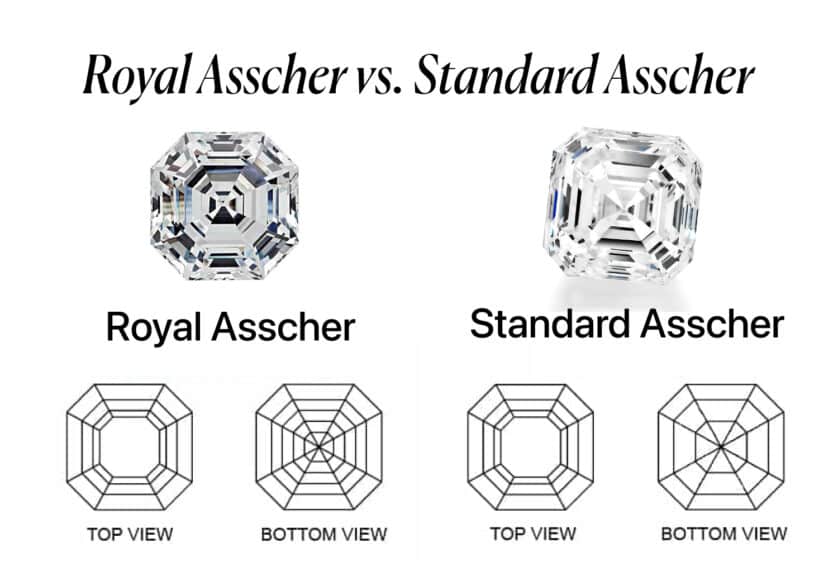
Mistake #6: Royal vs. Standard – Not Knowing the Facet Count
This is the “Insider Secret” that confuses most buyers. There are actually two types of Asscher cuts, and the GIA report often doesn’t distinguish between them clearly in the main description.
1. The Standard Asscher (58 Facets)
This is the original 1902 design. It has 3 rows of steps on the top and bottom.
- The Look: Classic, calm, deep. It has fewer flashes, but they are bigger and bolder.
2. The Royal Asscher (74 Facets)
This is the modern, patented update. It adds extra rows of facets on the bottom.
- The Look: Brighter, busier, and more “scintillating.” It bridges the gap between a step cut and a brilliant cut.
The Mistake: Buying a Standard Asscher expecting it to sparkle like a Royal Asscher (or vice versa).
The Fix: Count the steps in the video.
- Standard: Has a calm “Hall of Mirrors” vibe.
- Royal: Has a “Kaleidoscope” vibe.
- Note: Genuine “Royal Asscher” branded stones carry a significant price premium.
Mistake #7: The “Windowing” Failure (See-Through Stones)
Because Asschers have a low crown and flat table, poorly cut stones suffer from Windowing.
- What is it? When you look through the center of the stone, the light leaks out the back instead of reflecting up. You can literally see the band of the ring through the diamond.
- Why it happens: The angles of the “steps” are too shallow.
- How to spot it: Place your finger behind the diamond (or look for the setting bar in the 360-video). If you can clearly see the metal line running through the middle of the gem, it is a “Windowed” stone. It will look lifeless on your hand. A high-quality Asscher should reflect light back, obscuring whatever is behind it.
Mehedi’s Buying Verdict: The 2026 Asscher Cheat SheetDon’t let the technical specs overwhelm you. Stick to these four hard rules to ensure you get a stunner:
- Clarity: VS2 or better (Eye-Clean is non-negotiable).
- Depth: 61% to 68% (Avoid the “Small Rock” syndrome).
- Ratio: 1.00 to 1.05 (Keep it square).
- The Windmill: Verify the “X” pattern in the center using 360-degree video.
Royal Asscher vs. Standard Asscher: What’s the Difference?
Alright, let’s dive into one of the most important and least understood aspects of this unique diamond shape. When you’re shopping, you might see the term “Asscher cut,” and then, in a more exclusive corner of the market, the term “Royal Asscher.”
This isn’t just a marketing gimmick; these are two distinct “personalities” of the same cut, with different histories, different facet patterns, and different visual effects. Understanding this is key to knowing exactly what you’re buying.
The Standard Asscher Cut: The Widespread Classic
The Standard Asscher Cut is the beautiful, iconic shape that Joseph Asscher invented back in 1902. This is the design with 58 facets that became the darling of the Art Deco movement.
Here’s the critical piece of information you need to know: Joseph Asscher’s original patent on this cut expired long ago. This means that today, any diamond cutter in the world can cut a diamond to these classic proportions.
When you see a GIA report that describes a stone’s shape as a “square emerald cut,” they are, in almost all cases, referring to this unbranded, standard Asscher cut. It is the widespread, accessible, and timeless version of the shape.
The Royal Asscher Cut: The Modern, Branded Successor
In 2002, on the 100th anniversary of the original invention, the descendants of Joseph Asscher—the Royal Asscher Company—decided to update their masterpiece for the modern era.
They created the Royal Asscher Cut, a new, patented design that can only be cut by their own master craftsmen.
They made two significant changes to enhance the stone’s performance:
- They Added More Facets: The original has 58 facets. The Royal Asscher has 74 facets, with an extra row of facets on the pavilion. This creates more surfaces for light to bounce off, significantly increasing the diamond’s brilliance and scintillation.
- They Raised the Crown: The Royal Asscher has a noticeably higher crown (the top part of the diamond). This is a nod to the original antique diamonds and helps to create more fire and a brighter, more captivating look.
The following table breaks down the key differences at a glance:
| 2026 Feature Index | Standard Asscher Cut | Royal Asscher Cut |
|---|---|---|
| Heritage & Origin | Invented in 1902 by Joseph Asscher. Today, “Asscher Cut” is a generic industry term for square step-cuts. | Patented in 2002 by the Royal Asscher Diamond Company (descendants of Joseph). |
| Facet Count | 58 Facets (Standard step-cut pattern). | 74 Facets (Includes 16 additional pavilion facets). |
| Crown Architecture | Standard Crown Height. Offers a classic, planar look. | Notably Higher Crown. Designed to intensify light dispersion and fire. |
| Light Performance | Serene, mirror-like depth. Focuses on clarity over sparkle. | Vivid & Radiant. Combines step-cut depth with modern “brilliant” scintillation. |
| Availability & Price | Widely available from most retailers (James Allen, Blue Nile). Lower Price Premium. | Highly Exclusive. Available only through authorized dealers. Commands a 50-100% premium over standard cuts. |
| The 2026 Expert Verdict: For most buyers, a well-proportioned Standard Asscher Cut offers the best value-to-aesthetic ratio. However, if you are a collector seeking the absolute pinnacle of step-cut light performance and “Royal” exclusivity, the Royal Asscher is inimitable. Always look for the laser-etched “Royal Asscher” logo on the girdle to verify authenticity. | ||
My Mehedi Explanation
Here’s the simplest way to think about the difference. Think of the Standard Asscher Cut as the original, theatrical release of a classic film. It’s the version everyone knows and loves, the one that became a legend. It’s pure, deep, and historical.
Now, think of the Royal Asscher Cut as the 4K, remastered Director’s Cut that was released 100 years later. The director (the Asscher family) has used modern technology to make the picture brighter, sharper, and they’ve added a few extra “scenes” (the extra facets) to give it more energy and sparkle. The core story is the same, but the visual experience is more intense.
So, which one is right for you? If you want the guaranteed, branded “best of the best” with a bit more modern sparkle, the Royal Asscher is an incredible (though much rarer and more expensive) choice.
If you love the classic, deep, Art Deco look and want a wider selection to choose from, the standard Asscher is your perfect, timeless match.
The Blueprint: How to Buy the Perfect Asscher Cut
Alright, we’ve established the history and the two “personalities” of the Asscher cut. Now, we get to the most important part: the blueprint. This is my exact, step-by-step process for selecting a truly spectacular Asscher.
Because the Asscher is a step cut, the usual rules of the 4Cs are turned on their head. For a brilliant cut, you prioritize Cut above all else. For an Asscher, the hierarchy is different. Follow these steps in this exact order to ensure you find a stunning diamond and incredible value.
Step 1: Prioritize Clarity (Your #1 Non-Negotiable)
With a brilliant cut, a fiery sparkle can hide a multitude of sins. An Asscher cut, however, has nowhere to hide. Its beauty is its large, open table and deep, clear facets—it’s like a crystal-clear window into the very soul of the diamond. This is why clarity is, without a doubt, your single most important priority.
An inclusion that would be completely invisible in a round brilliant can look like a glaring flaw right in the middle of that window. You absolutely cannot compromise here.
Your Asscher Cut Clarity Guide
| Clarity Grade | Mehedi’s 2026 Expert Verdict | Visual Reliability |
|---|---|---|
| SI1 / SI2 | Extremely Risky. Step-cuts multiply flaws. Finding an eye-clean stone in this range is like finding a unicorn. | High risk of visible black crystals or feathers in the center table. |
| VS2 | The Smart Money. This is my baseline recommendation. Inclusions are typically microscopic and invisible to the naked eye. | Excellent Value. The ideal 2026 balance of price and aesthetics. |
| VS1 | The Worry-Free Zone. You are virtually guaranteed an eye-clean stone with no visible flaws. | A very safe and high-performance choice for a premium look. |
| VVS2+ | The Collector’s Grade. Flawless to the eye, but you are paying a huge premium for perfection you cannot actually see. | Stunning on paper, but offers no added visual benefit over a clean VS1. |
| The 2026 Technical Insight: Because the Asscher is a step-cut, it acts like a window. While a Round Brilliant can hide an SI1 inclusion under its sparkle, an Asscher will reveal it. Always aim for an eye-clean VS2 Clarity Diamond as your minimum. For a deeper dive into why clarity is king for this shape, read my full Asscher Cut Diamond Guide. | ||
For a complete breakdown of what these grades mean across all shapes, our full guide on what is the best diamond clarity is an essential read.
Step 2: Judge the Cut (Using Your Eyes and the Certificate)
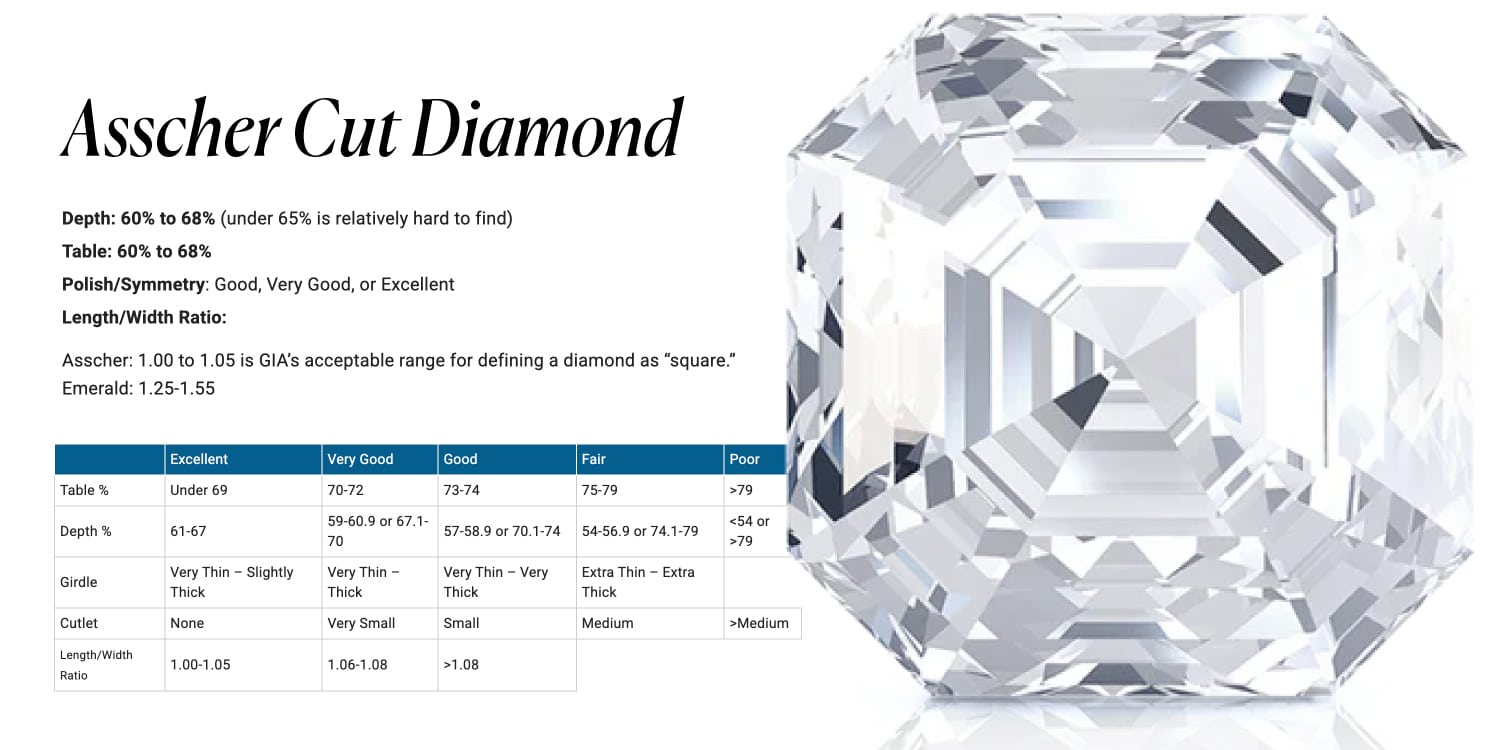
This is the trickiest part of buying an Asscher, so let’s be very direct: The GIA certificate for an Asscher cut diamond does NOT have an overall Cut grade.
This means you have to be the judge. To do this, we use a two-step process: first, we use the certificate’s numbers to filter out the poorly proportioned stones, and second, we use our own eyes to judge the final beauty.
Mehedi’s Expert Starting Point for Asscher Proportions
- Table %: 61% to 69%
- Depth %: 61% to 67%
- Girdle: Very Thin to Slightly Thick
- Culet: None
Use these numbers as your initial search filters. They will help you create a shortlist of diamonds that are likely to be beautiful. But this is not a guarantee.
The “Hidden” Grades You Must Demand
This is a critical pro tip that most guides miss. On the GIA certificate, there are two other cut-related grades that are absolutely essential for a step cut like an Asscher:
- Polish: This must be “Excellent.” It refers to the smoothness of the facets. A poor polish will make the “mirrors” in your hall-of-mirrors look smudged.
- Symmetry: This must be “Excellent.” It refers to the alignment and shape of the facets. Poor symmetry in a step cut is glaringly obvious and will make the entire pattern look wobbly and off-kilter.
The final step is to watch the 360-degree video. Look for that mesmerizing, symmetrical “X” or “windmill” pattern in the center. A well-cut Asscher will have crisp, clean lines and a beautiful on/off flash of light as it moves.
DIAMOND ON SALE!!
⏰ Tick-Tock! The Best Diamond Deals at James Allen Are Disappearing Fast!
Step 3: Find the Color Sweet Spot
Just like with clarity, the Asscher cut’s clean, open window is not very forgiving when it comes to a diamond’s body color. That faint warmth that would be hidden by the fire of a brilliant cut can be more noticeable in the deep facets of an Asscher.
My recommendation is to choose your color grade based on the metal you plan to set it in.
Your Asscher Cut Color Guide
For a deep dive on why that H color grade is such a powerhouse of value, our H Color Diamond Pricing Tips guide has everything you need to know.
The Showdown: Asscher Cut vs. Its Main Rivals
You’ve learned how to pick a beautiful Asscher, but the final step is being 100% confident it’s the right shape for you. An Asscher is a very specific choice, and it’s essential to understand how it stacks up against its closest competitors.
Let’s put it head-to-head with its three main rivals so you can be certain you’ve found your perfect match.
Asscher vs. Emerald Cut (The Battle of the Step Cuts)
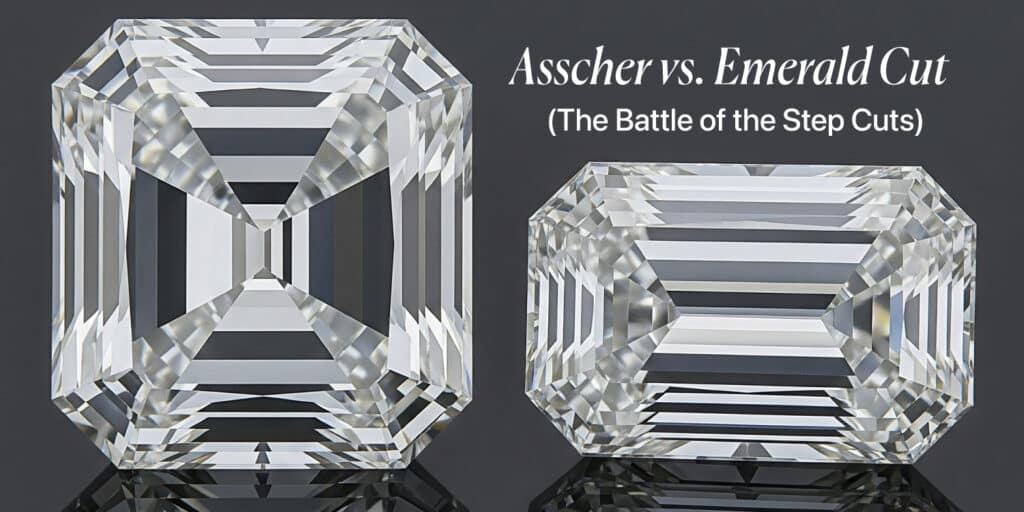
This is the most common and crucial comparison, as these two shapes are siblings. They are both step cuts, meaning they are designed for clarity and a “hall-of-mirrors” effect. Their soul is the same; only their body is different.
Best Deal Of The Year – Final Days
Blue Nile’s “Clear The Vault” is ON.
Shop Fine Jewelry Upto 70% OFF.
*Exclusions may apply. See Blue Nile for complete details.
Your At-a-Glance Guide: Asscher vs. Emerald
| Feature | Asscher Cut | Emerald Cut |
|---|---|---|
| Silhouette | Octagonal Square (Ideal Ratio: 1.00 – 1.05) | Octagonal Rectangle (Ideal Ratio: 1.30 – 1.50) |
| Sparkle Pattern | The “Windmill” effect. Concentric square facets drawing the eye to the center. | The “Hall-of-Mirrors” effect. Long, rectangular parallel facets. |
| Visual Vibe | Art Deco, Bold, and Architectural. | Classic, Sophisticated, and Understated. |
| Best For… | Those who prioritize symmetry and depth. | Those who want to elongate the finger visually. |
| The 2026 Buying Verdict: Both shapes are step-cuts, meaning they act as a window into the stone. Because of this, you must prioritize clarity. For the square silhouette, check our Asscher Cut Guide, or for the rectangular version, see our Emerald Cut Buying Strategy. | ||
The Mehedi Breakdown:
The choice here is purely about the silhouette you love most.
- The Look: An Asscher cut is for the lover of perfect, mesmerizing symmetry. Its concentric squares draw your eye into the center, creating a hypnotic depth. An Emerald Cut Diamond is for the lover of sleek, elegant lines. Its rectangular shape creates a beautiful, finger-slimming effect and feels incredibly classic.
- The Price & Quality: From a technical perspective, they are identical. Both are excellent values, and both demand the exact same high standards for clarity (VS2+), color (H+), and symmetry (Excellent).
Asscher vs. Princess Cut (The Battle of the Squares)
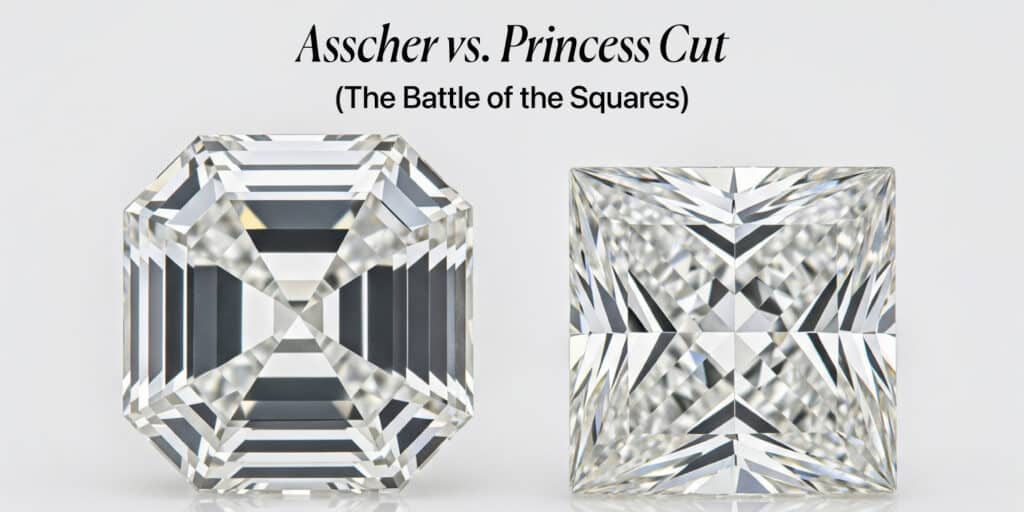
This is a comparison of two very different philosophies of a square diamond: the vintage, deep flash of the Asscher versus the sharp, fiery sparkle of the Princess.
Your At-a-Glance Guide: Asscher vs. Princess
| Comparison Feature | Asscher Cut | Princess Cut |
|---|---|---|
| Sparkle Style | Step Cut. Offers deep, hypnotic flashes and a “Hall-of-Mirrors” effect. | Brilliant Cut. Designed for intense, fiery scintillation and maximum sparkle. |
| Corner Anatomy | Cropped Corners. An octagonal outline that adds durability and vintage flair. | Sharp Corners. Perfectly square; requires a V-prong setting to prevent chipping. |
| Clarity Threshold | Very High (VS2+). The open table acts as a window; inclusions are easily spotted. | Medium (SI1+). The busy facet pattern is excellent at “hiding” small inclusions. |
| Visual Vibe | Sophisticated, Art Deco, and architectural. | Modern, bold, and brilliantly energetic. |
| 2026 Durability | Excellent. The sturdiest of the square shapes. | Good. Beautiful, but high-risk for active lifestyles without proper protection. |
| The 2026 Buying Verdict: If you want the sturdiest and most elegant square shape, the Asscher Cut is your winner. However, if your priority is maximum sparkle and a more modern look, our Princess Cut Diamond Guide will show you how to find a high-performing stone while protecting those sharp corners. | ||
The Mehedi Breakdown:
This choice is all about the kind of sparkle and personality you want.
- The Sparkle: An Asscher cut, being a step cut, gives you those deep, clear, almost watery flashes of light. A Princess cut is a “brilliant” cut, designed with many triangular and kite-shaped facets to create a vibrant, fiery, almost splintery sparkle. If you want a disco-ball effect, the Princess is your winner.
- The Vibe: The Asscher is pure vintage Art Deco. The Princess is a sharp, modern, and high-energy choice.
- The Value: While both offer a good price-per-carat, the Princess cut has a major advantage: its brilliant sparkle is fantastic at hiding inclusions. This means you can often find a stunning, eye-clean SI1 Princess, while an Asscher almost always requires a more expensive VS2. For a complete guide to this sharp competitor, check out our Princess Cut Diamond Ring Guide.
Read Our 5-Star Blue Nile Review
Check our comprehensive Blue Nile review to learn why we rated Blue Nile 5 stars for their exceptional quality and value.
Asscher vs. Cushion Cut (The Battle of the “Antique” Styles)
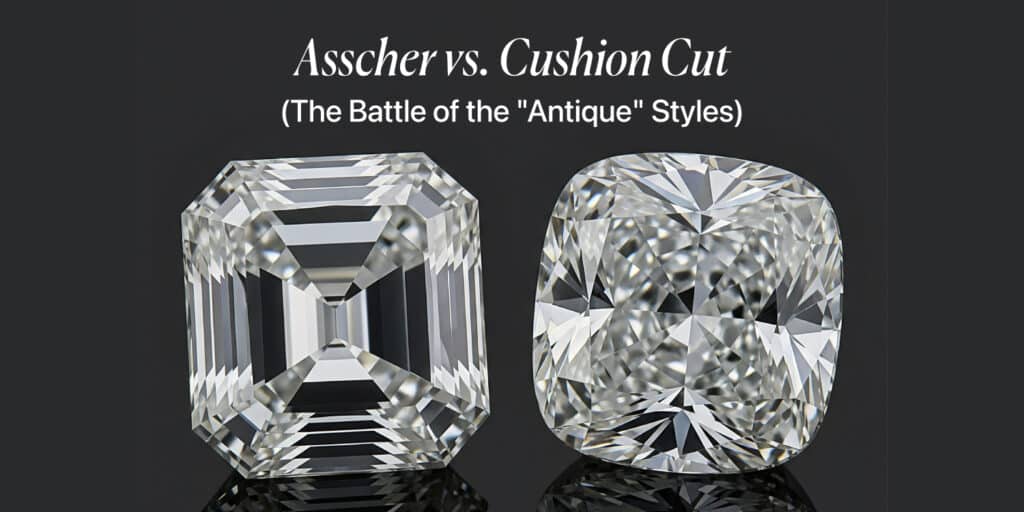
This is a showdown between two shapes with deep historical roots, but very different personalities. It pits the bold, geometric glamour of the Art Deco 1920s against the soft, romantic feel of the Victorian 1800s.
Your At-a-Glance Guide: Asscher vs. Cushion
| Comparison Feature | Asscher Cut | Cushion Cut |
|---|---|---|
| Shape & Outline | Geometric Square. Features distinct cropped corners for an octagonal profile. | Soft “Pillow” Square. Features rounded corners and curved sides for a romantic look. |
| Visual Presence | Architectural Depth. Focused on structural symmetry and vintage Art Deco vibes. | Soft Elegance. Focused on warmth, femininity, and versatile fashion appeal. |
| Sparkle Profile | Step Cut. Uses parallel facets to create the iconic “Hall-of-Mirrors” look. | Brilliant Cut. Uses triangular facets to create fiery “Crushed-Ice” or “Chunky” sparkle. |
| Clarity Tolerance | Low (VS2 Minimum). Large open facets show inclusions easily; clarity is your primary investment. | High (SI1 Friendly). Complex sparkle patterns are excellent at “hiding” small inclusions. |
| The 2026 Buying Verdict: If you are drawn to clean lines and vintage prestige, the Asscher Cut is inimitable. However, if you want a soft, feminine sparkle that offers the best value for your budget, our Cushion Cut Diamond Guide will show you how to find the perfect balance of color and clarity. | ||
The Mehedi Breakdown:
This decision is based on the feeling you want your ring to evoke.
- The Shape & Vibe: An Asscher is defined by its straight lines and clean angles. It feels intentional, architectural, and glamorous. A Cushion, with its soft, rounded “pillow” corners, feels romantic, classic, and gentle.
- The Sparkle: Again, we are comparing a step cut (Asscher) to a brilliant cut (Cushion). The Cushion will have that more traditional, fiery “sparkle” and does a much better job of hiding inclusions.
- The Nuance: The Cushion cut is a famously complex shape with its own “personalities” that a buyer must understand. For a full masterclass on its unique styles, our guide, 7 Mistakes to Avoid When Buying a Cushion Cut Diamond, is an absolute must-read.
James Allen: Our 5-Star Choice for Price and Selection
Check our comprehensive James Allen Review to learn more about their pricing and commitment.
Is an Asscher Cut More Expensive?
Let’s tackle the big question on every smart buyer’s mind: the price tag. With a shape this unique, royal, and historically significant, you’d be forgiven for assuming it comes with a massive premium.
But here is the simple, fantastic truth: no, an Asscher cut is not more expensive. In fact, it is one of the best values in the diamond world.
On average, you can expect an Asscher cut to be priced 20-30% lower than a round brilliant diamond of the exact same carat weight and quality.
Why? It comes down to simple geometry and efficiency. The square-ish shape of an Asscher cut conforms very closely to the natural octahedral shape of a rough diamond crystal.
This means that a master diamond cutter can preserve a much higher percentage of the original raw material when creating an Asscher. There is significantly less waste compared to cutting a round diamond, where all four corners of the crystal must be ground away.
That higher “yield from rough” means a lower cost for the finished diamond, and that savings is passed directly on to you.
To give you a real-world idea of what this value looks like, here is a sample pricing table for a high-quality natural Asscher cut diamond, using our “sweet spot” recommendations of H color and VS2 clarity.
| Carat Weight | Typical 2026 Price Range (H/VS2) | Mehedi’s Expert Take: The Value Play |
|---|---|---|
| 1.00 Carat | $3,600 – $4,850 | A stunning, eye-clean stone for a price that would barely secure a 0.80ct Round Brilliant. This is exceptional technical value for entry-level luxury. |
| 1.50 Carat | $8,500 – $11,200 | At this size, the “Windmill” effect becomes truly mesmerizing. You are securing a major, impactful center stone for significantly less than a comparable Oval or Round. |
| 2.00 Carat | $14,500 – $19,500 | A true heirloom showstopper. In early 2026, a 2ct Asscher remains tens of thousands less than a 2ct Round, despite its prestigious architectural profile. |
| The 2026 Saving Strategy: Because Asscher cuts carry weight in their depth, a 1.00ct stone can look small. If budget allows, the 1.50ct mark is where the visual ROI peaks. Always ensure you are buying at least a VS2 Clarity Diamond to keep those step-cut facets clean. For more pricing secrets, read my full Asscher Cut Diamond Guide. | ||
For a real-world example of this incredible value, you can look at a beautiful 1.04 Carat, H Color, VVS2 Clarity Asscher cut like this one from James Allen.
Or, if you want to see how that scales, look at a gorgeous 1.51 Carat, G Color, VS1 Asscher from James Allen. You will see a breathtaking diamond at a price that feels incredibly fair.
A Visual Guide to Asscher Cut Sizes
Now that we know the value is incredible, let’s talk about the visual size. This is where I need to give you some honest, “friend in the business” advice.
When you choose an Asscher, there is a crucial trade-off you make between its unique sparkle and its face-up size.
The mesmerizing “hall-of-mirrors” effect of an Asscher is created by its deep pavilion. The facets are cut deep into the stone to create that incredible, hypnotic depth. However, this means that a significant portion of the diamond’s carat weight is “hidden” in that depth.
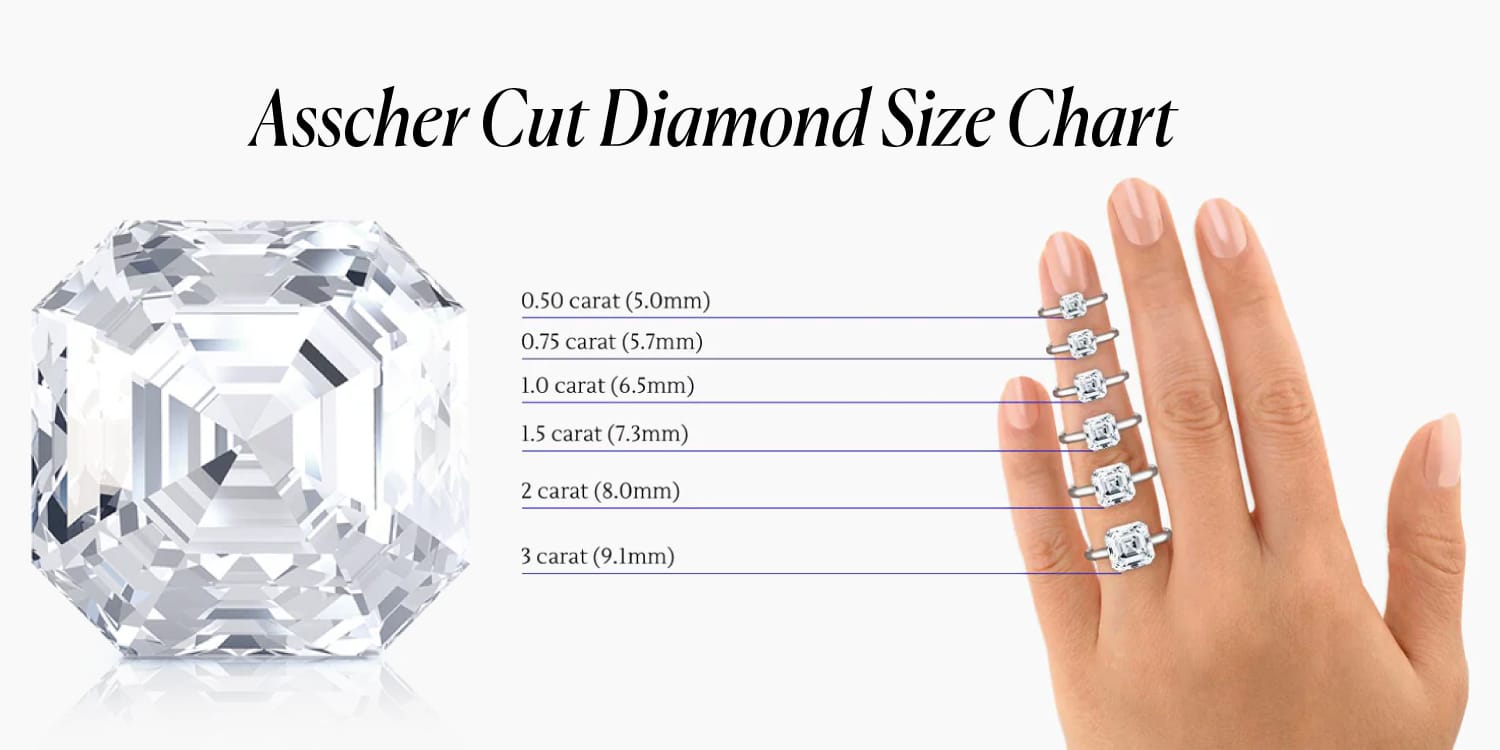
I use the “iceberg analogy” with my clients. An Asscher cut is like an iceberg: a huge amount of its mass is below the surface, and that is precisely what creates its deep, soulful beauty.
This can mean that an Asscher cut will look slightly smaller on the finger than a round brilliant of the exact same carat weight.
Here is a visual guide to the typical face-up measurements (in millimeters) you can expect for a given carat weight.
Asscher Cut Diamond Size Chart
| Carat Weight | Face-Up Size (MM) | 2026 Visual Comparison |
|---|---|---|
| 0.50 Carat | ~4.45 mm | Understated & Delicate. |
| 1.00 Carat | ~5.50 mm | The Classic Engagement Standard. |
| 1.50 Carat | ~6.50 mm | Substantial Presence. |
| 2.00 Carat | ~7.00 mm | The Luxury Sweet Spot. |
| 3.00 Carat | ~8.00 mm | High-Impact Heirloom Size. |
| 4.00 Carat | ~8.90 mm | Serious “Statement” Territory. |
| 5.00 Carat | ~9.45 mm | Ultimate “Royal” Scale. |
| The 2026 “Spread” Strategy: Because Asscher cuts are naturally deep, they often look smaller than their weight. If you want a larger appearance, look for an Asscher Cut with a depth percentage between 60-67%. This pushes more weight to the surface, making the diamond face up larger without increasing the cost. | ||
As you can see, a 1-carat Asscher is typically around 5.5mm x 5.5mm. This isn’t a “con”—it is a characteristic. You are trading a small amount of face-up “spread” for an enormous gain in unique character and depth.
To see a full, side-by-side comparison of how these dimensions stack up against every other shape, you absolutely must have our comprehensive Diamond Carat Size Chart open in another tab. It is an indispensable tool for every savvy buyer.
Optical Precision: Audit the “Windmill” pattern in 40x Super-Zoom HD. Secure GIA-certified Asscher cuts and True Hearts™ signature styles with 20% OFF settings at James Allen .
Elite Vault: Access the Clear The Vault Sale for premium Asscher Cut inventory. Explore the Astor by Blue Nile collection for the ultimate in Art Deco brilliance at Blue Nile .
How to Frame Your Art Deco Masterpiece
You’ve done the hard work. You’ve mastered the 4Cs for this unique cut, and you’ve found a spectacular, eye-clean Asscher that has that hypnotic flash you love. Now for the final, wonderful decision: choosing the perfect frame for your masterpiece.
An Asscher cut has such a strong, architectural personality that your choice of setting is crucial. The goal is always to complement its clean lines, not compete with them.
Here are the three styles that I recommend to my clients time and time again because they perfectly honor the Asscher’s unique beauty.
1. The Solitaire Setting: The Icon
- Who it’s for: The purist, the minimalist, the person who believes the diamond is the one and only star of the show.
- Why it works: A simple four-prong solitaire setting is arguably the best way to showcase the Asscher’s unique geometry. It lifts the diamond up to the light and leaves it completely open on all sides, allowing you to fully appreciate its deep corners and mesmerizing “hall-of-mirrors” effect. It’s a choice of pure, timeless confidence.
- A Perfect Example: Look no further than this stunning and simple Platinum Solitaire from Blue Nile. It’s the definition of classic elegance.
2. The Three-Stone Setting: The Architectural Statement
- Who it’s for: The lover of symmetry, symbolism, and a truly substantial look.
- Why it works: Flanking a central Asscher with two smaller side stones is a breathtaking look with a powerful story. You can use two smaller Asscher cuts for a perfectly symmetrical, step-cut masterpiece, or you can use tapered baguette diamonds, like in this incredible Tapered Baguette Setting from James Allen.
The long, clean lines of the baguettes act as perfect “leading lines,” drawing your eye directly to the magnificent center stone. It’s a true Art Deco statement.
3. The Delicate Halo Setting: The Soft Glamour
- Who it’s for: The person who loves the Asscher’s vintage vibe but also wants an extra touch of brilliant sparkle.
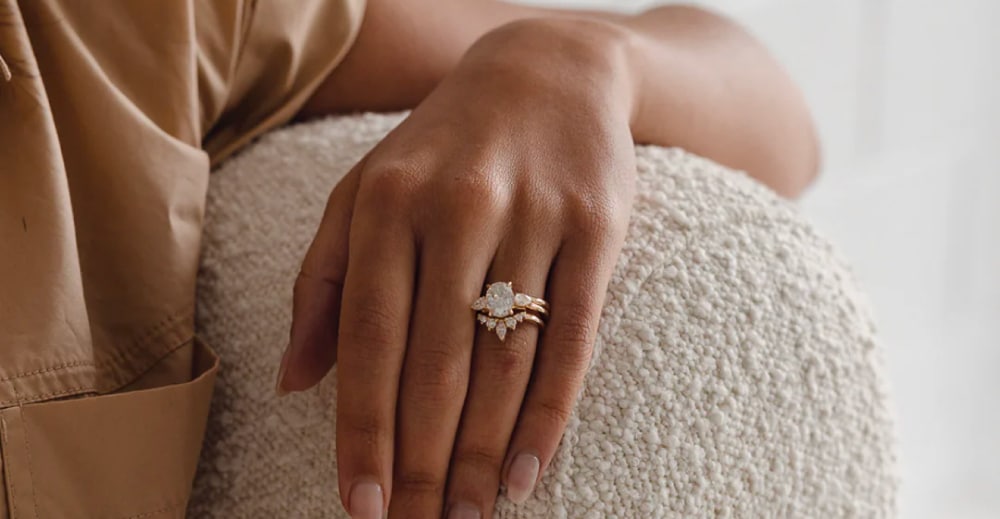
- Why it works: A halo of small, round brilliant diamonds creates a beautiful textural contrast against the clean, glassy flashes of the Asscher cut. The halo’s sparkle frames the center stone perfectly, can make it appear significantly larger, and adds a touch of soft, romantic glamour to the ring’s bold geometry. It’s the best of both worlds.
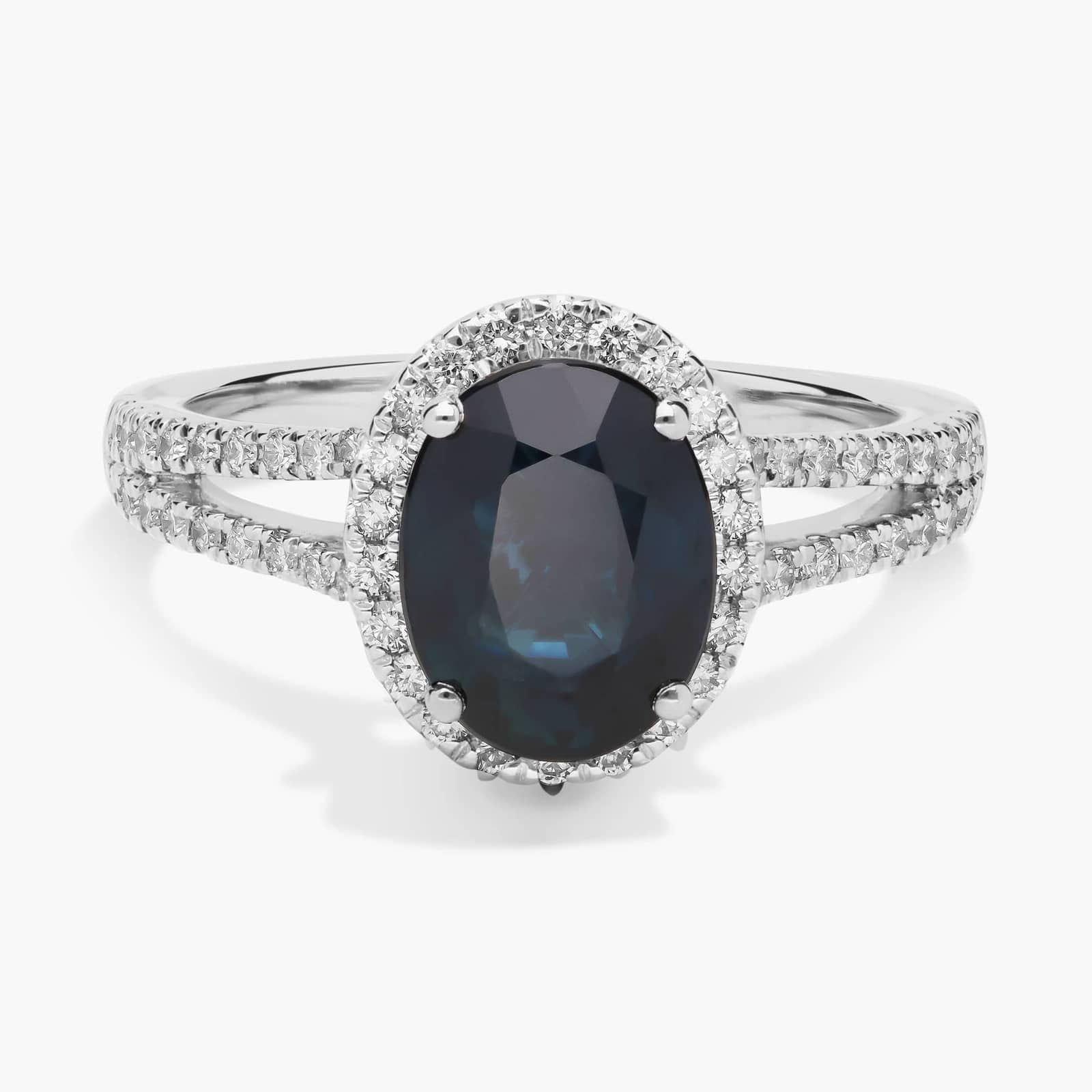
- A Perfect Example: This Petite Milgrain Halo Ring from Blue Nile is a masterclass in this style, with the vintage milgrain detailing perfectly complementing the Asscher’s historic soul.
Every Asscher Cut Diamond Question, Answered by an Expert
You’ve got the blueprint, but the world of Asscher cuts is filled with nuance and specific, important questions. I’m going to tackle every single one of your queries here, giving you the direct, honest answers you need to become a true connoisseur of this incredible diamond shape.
The Verdict: A Shape for the True Connoisseur
The Asscher cut is not a diamond that shouts; it’s one that speaks. It’s a choice for someone who appreciates the art of diamond cutting, the allure of vintage history, and the mesmerizing beauty of perfect, window-like clarity. It doesn’t try to be the sparkliest diamond in the room; it’s confident in its own cool, sophisticated fire.
You now have the knowledge that most buyers never get. You understand the difference between its royal and standard forms, the critical importance of prioritizing clarity and symmetry, and how to see its unique magic with your own eyes. Choose it with the confidence of the connoisseur you have become.
James Allen is a top leader in online diamond sales, offering cutting-edge imaging technology that lets you inspect diamonds as if you were using a jeweler's loupe. With the largest exclusive selection of loose diamonds available online and excellent pricing, they also boast one of the finest collections of lab-created diamonds on the market. They currently run a 25% discount on selected lab-grown diamonds!
WHAT WE LOVE ABOUT THEM:
- 30-day no-questions-asked return policy, with a prepaid shipping label provided by James Allen.
- Lifetime warranty on all purchases.
- Free international shipping.
- Complimentary prong tightening, repolishing, rhodium plating, and cleaning every six months.
- Insurance appraisals included with purchases.
- One free resizing within 60 days of purchase.
- Free ring inscriptions available.
- Best-in-class high-quality imagery for every diamond in stock.
- 24/7 customer support.
- Premium, best-in-class packaging.


Blue Nile is one of the biggest and most recognized online jewelry retailers, offering an extensive and exclusive inventory. Their high-resolution images are improving and getting closer to the quality offered by James Allen, while their prices remain highly competitive. Right now, Blue Nile offers up to 30% savings on jewelry during a limited-time sale.
WHAT WE LOVE ABOUT THEM:
- 30-day no-questions-asked return policy, with a prepaid shipping label provided by Blue Nile.
- Lifetime warranty on all purchases.
- Free shipping on every order.
- Complimentary services every six months, including prong tightening, repolishing, rhodium plating, and cleaning.
- Insurance appraisal included with your purchase.
- One free resizing within the first year.
- High-quality images available for roughly half of their diamond selection.
- 24/7 customer service support.
- Full credit toward future upgrades, as long as the new item is at least double the value.
- Best-in-class order fulfillment process.